

GraphicNovel tutorials / Reference Bible
Graphic Novel: Lesson 1 — Skin That Rabbit First
The reference Bible: give the artist something to work with.
You might not know you need this. I didn’t. I wrote an unusual love story and decided it should be a graphic novel. Sketches, dialogue, character descriptions, paid artist’s impressions. The results weren’t great. Fair feedback: I hadn’t given the artists enough to work with.
“Fine. I’ll skin that rabbit first. And count the pages and panels.” The story spanned forty years. Changing appearances, clothes, acquired scars. “And that.” Above a certain length, the bits need managing.
The Bible
Nicked from the film industry: an authoritative source of information, separate from the story you’re telling. Define the details once. Give the collaborators somewhere to check them.
Meet Lana, my favourite institutional director, on secondment to Media Matter’s attempt to preserve knowledge permanently and visually in granite and gold. The project is insane. I love it.
Awww, fuck. I called her Lana when the Bible says Lara. Hoisted by my own technique. The Bible is right and I am wrong.
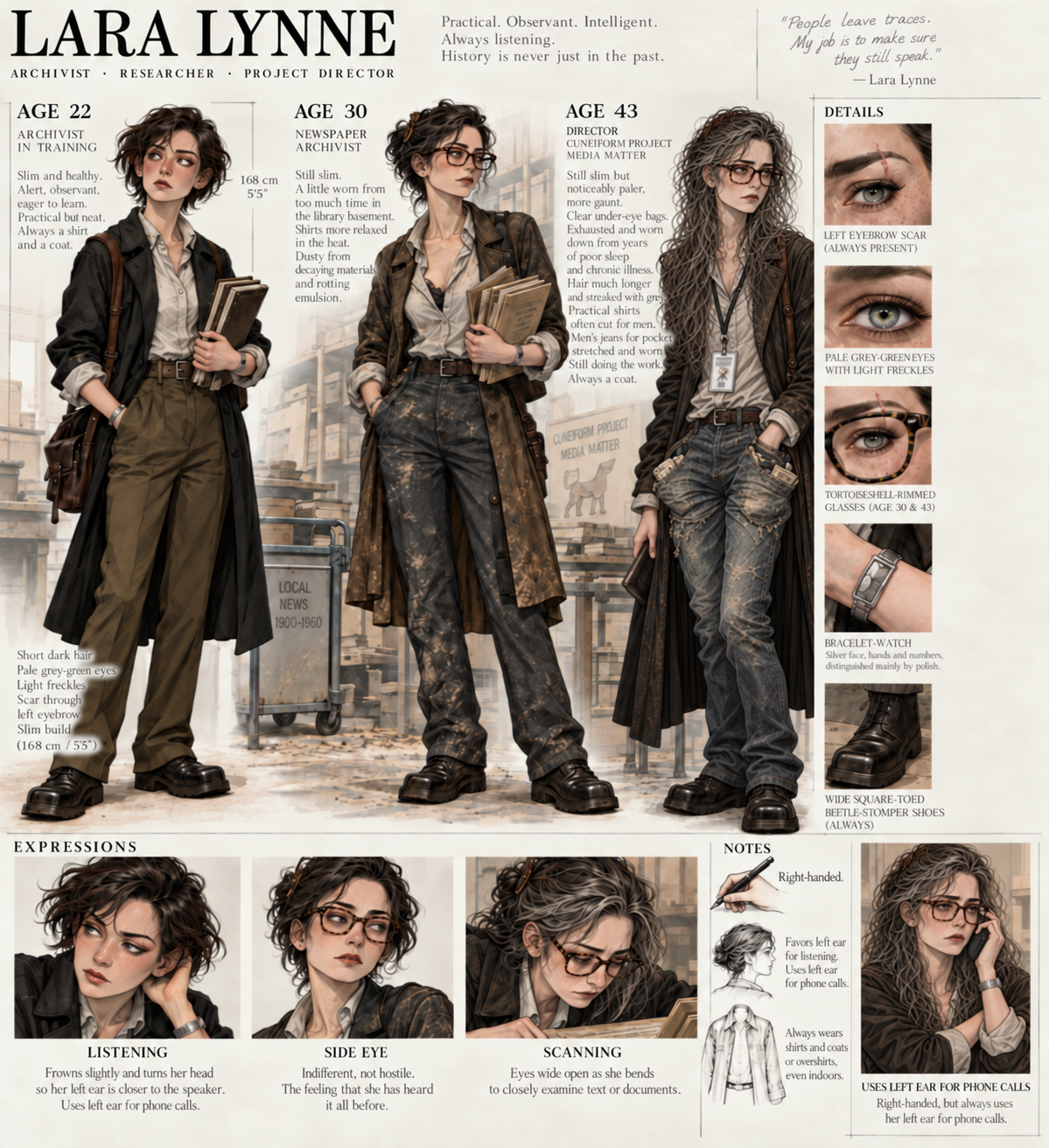
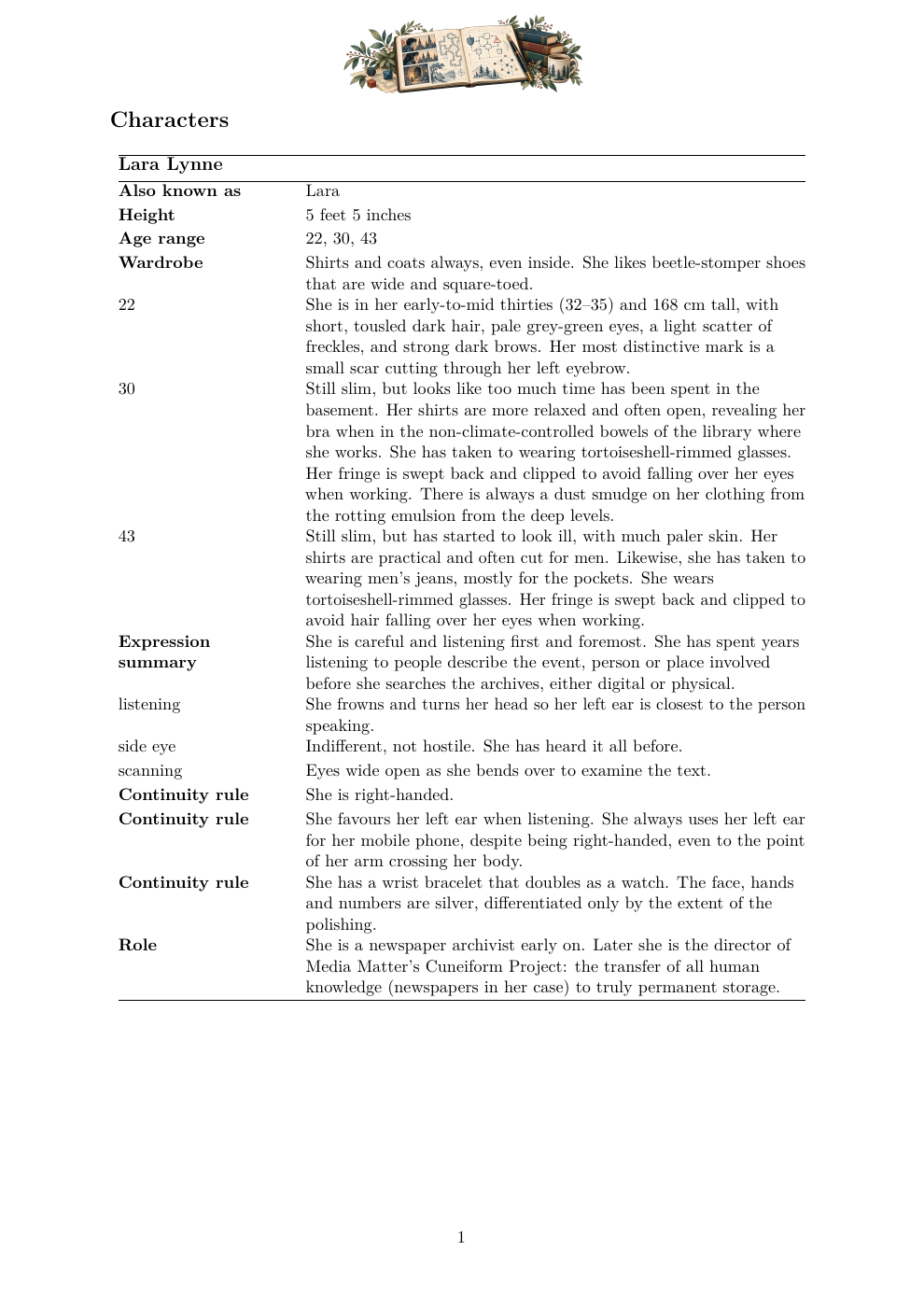
What’s happening to Lara? Reveal the story spoiler.
Lara has radiation poisoning from thorium dioxide in the cuneiform clay tablets she works with. In this story, the material contains an alpha-emitting isotope. Her work is killing her.
A bad habit
I found hundreds of character descriptions like this in the comic-script archive. Pages of capitals, with core details buried in the prose:
LARA LYNNE, AN ARCHIVIST, RESEARCHER, AND PROJECT DIRECTOR DEFINED BY THE PHILOSOPHY THAT “PEOPLE LEAVE TRACES; MY JOB IS TO MAKE SURE THEY STILL SPEAK,” EMBODIES A PRACTICAL, SHARP, AND RELENTLESSLY OBSERVANT DISPOSITION…
Or you can give those details names and put them in the table above. Here’s the source. Change something and see what happens.
Notice \charfield{Role}{...}. It supplies background context, rather than an appearance specification. The artist used that context for the Cuneiform Project / Media Matter lanyard and signage, without a panel description asking for them.
Try one change
Change Lara’s wardrobe, or the description of her “side eye” expression. Click Make PDF and find the changed row. For this lesson, keep the character name, era labels and command structure as they are. Reset example restores the starting definition.
Consistency Checks
Problems will be listed here.
Character Bible PDF
Compile to see the updated table.