

GraphicNovel tutorials / Lesson 5
Periods & Eras
Same subject. Different periods. Different appearances.
We’ve mentioned time periods as ‘eras’ without explaining what they are. That was aeons, millennia, centuries, decades, years and seasons ago. So let’s swallow that wasp. And while we’re at it, show how they should be used.

Take Lana. We meet her in her early forties, after twenty years working. There were twenty years before she started work, and there may be decades afterwards. How much of that matters depends on the story. Here she is at twenty, forty-five and seventy.

Likewise, a building might be a ruin after WWII, rebuilt in the 1960s and abandoned in 2020. Three different times and three different looks. Well, conditions. Umm, looks and conditions.
Eras are labels, not calculations. They are writers’ and artists’ notes. If Lana was born in 1986 and you place her aged forty in the sleazy dive bars around King’s Cross Station in the eighties—I remember them well—that’s your lookout.
The checker checks that an era exists and that a character, location or prop has an appearance defined for it. It does not calculate anyone’s age or check your chronology. Those features might be added if I get bored, drunk or nagged. They don’t exist now.

Eras don’t mean years specifically. Stone, Bronze, Iron, Steel and Silicon are all valid names. The pictures use Stone, Bronze, Steel and Silicon. Name the periods your story needs. Describe what changes.

Spring, Summer, Autumn and Winter work too. Just describe them. Apparently autumn also needs a dry cleaner.
Present time
“Now” means the present of your story, not the date on your computer. In version 0.5 it is not an automatic default: declare it and select it like any other era.
\DeclareEra{Now}
\era{Now}
Enough talk. Hugs apply.
Declare the eras first. Capital D, capital E: command names are case-sensitive. The braces hold the name. These are code fragments, not a complete document.
\DeclareEra{1968}
\DeclareEra{2008}
\DeclareEra{2028}
Then set the current era in the script with era{2028}. An appearance belongs inside the character, location or prop’s Bible entry. We’ll come back to where everything lives.
\era{2028}\appearance{2028}{Lana's illness has taken its toll. She is now about seventy, extremely pale and physically frail, and has taken up smoking. She has discarded her long dark coat and now favours a purple coat with thin, sparse vertical yellow lines. Her pockets still bulge, and her hair is greyer, much longer and slightly greasy. Her watch is gone, replaced by a high-tech ring with a tiny screen, still in the same style: silver on silver on silver.}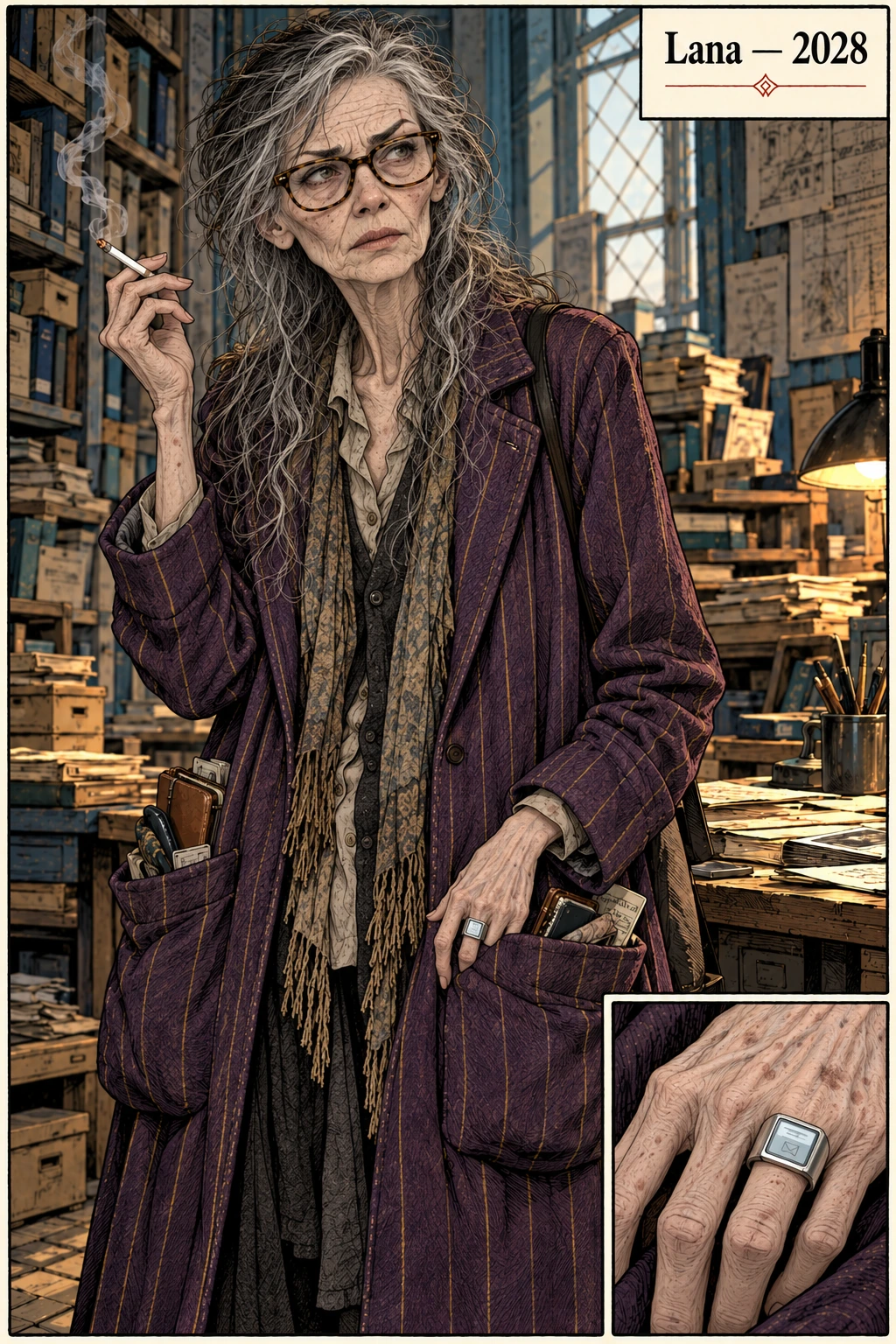
Next lesson: The Cafe on Hollingarth Road. Yeah, here come the commands.